making the markers disappear
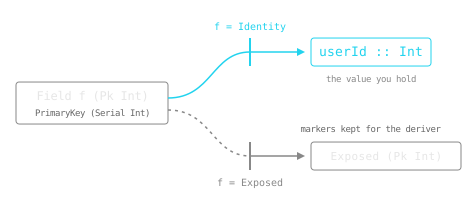
Part 1 left the record parameterised, and that parameter has a cost you feel at once. The
value you actually want to hold — a User you can pattern-match, print, pass around — is
buried. Write UserT f and userId has type Field f (Pk Int), which expands to
Field f (PrimaryKey (Serial Int)): a functor you have not yet chosen, wrapped around a
marker that stands in for “primary key, serial.” None of that is a number you can add to.
An ORM in another language would hand you a clean object and keep the schema details to one side, in a decorator or a registry. We have no runtime side to keep them on and no annotation syntax to strip them with. The markers live in the type, so the type is where they have to come off.
The way off is the smallest functor there is. Identity a holds an a and does nothing
else; mapping a function over it just applies the function. In the language of part 1 it is
the do-nothing container, and to a category theorist it is the identity functor: the one
that composes with any other functor and leaves it unchanged. If any choice of f should
give you the plain value back, it is this one.
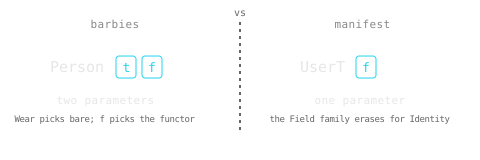
Choosing it does give you the plain value, though not the way barbies would. There a field
is f a, so User Identity would still leave you holding Identity Int, one wrapper to
peel. Manifest spends the choice differently. Field is a type family rather than plain
application: a function that runs in the compiler, taking types to types, that
pattern-matches on f:
type family Field f a where
  Field Identity a = Base a       -- the value you hold
  Field Exposed  a = Exposed a    -- the metadata the deriver reads
The Identity case throws the wrapper away and hands the rest to Base, a second small
family whose only job is to strip the markers down to the runtime type:
type family Base a where
  Base (PrimaryKey a) = Base a
  Base (Serial a)     = a
  Base a              = a
Run those and the noise unwinds a layer at a time:
  Pk Int  =  PrimaryKey (Serial Int)

  Field Identity (Pk Int)
    = Base (PrimaryKey (Serial Int))
    = Base (Serial Int)
    = Int                  (userId :: Int)

  Field Exposed (Pk Int)
    = Exposed (Pk Int)     (kept for the deriver)
So type User = UserT Identity makes userId :: Int, on the nose. The Pk Int marker did
its job (it told the deriver this column is a serial primary key) and then vanished from the
value, with no annotation written anywhere, because it was a fact about the type and the
type is what got rewritten.
The second branch is the one that keeps them. UserT Exposed resolves every field
through Field Exposed a = Exposed a, so the markers stay on, and the code that generates
schema reads them straight off. One declaration, two readings: the value forgets the
markers, the schema remembers them.
This is where the barbies comparison flips. barbies needs a second type parameter to reach
a bare record, a Wear/Bare/Covered machine layered over f, because its f a can
only ever wrap. Manifest reaches bare with one parameter by making Field a family and
letting Identity be the branch that erases. The price shows up the other way round:
Field f (Pk Int) reads heavier than f a, and you cannot tell at a glance that it is an
Int without knowing the family. barbies has the cleaner field type; manifest has the
cleaner record, and the markers besides. (barbies would never have carried the markers in
the first place, since it has no reason to read database meaning out of a field.)
Field family, so one parameter does what barbies needs two for.So the record now reads two ways from one declaration: a clean value under Identity, a
bag of schema facts under Exposed, written once. What it still cannot do is talk to the
database. Postgres deals in columns and bytes, not User values, so what comes next is the
round trip in both directions: a row decoded into a value, and a value encoded back into a
row, for as many fields as the record has and with no ceiling on the count.