the working, complete
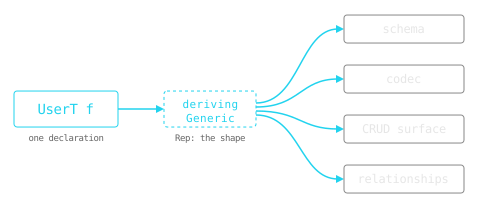
deriving (Generic): the schema, the codec, the CRUD surface, and the relationships all fall out of it.The signature that looked like noise on the very first line reads plainly now. Field f (Pk Int) is a field whose interpretation waits on f; Ent (Insert name l) is a row you are building that the types know is mid-construction. Nothing in either was decoration. Learning to read them was the whole point of the walk, and the walk is over, so they are just types.
What stays with you is smaller than any one of those, and it answers a question that hung over the start. Nobody had built a SQLAlchemy-style Unit-of-Work for Haskell, and the reason was never that nobody wanted one. The obvious design wants a session that watches your objects and flushes their changes, and watching changes means mutating the objects it watches. Haskell will not mutate. That looks like a wall, and for a long time it read as one.
It was the opposite. Immutability did not block the design; it ruled out the cheap version and left only an honest one, where every decision had to be paid for in the types instead of hidden behind a mutable cell. Each piece of category theory in the series was the smallest tool that kept one of those decisions honest. A functor parameter so a single record declaration is table, value, and query at once. The identity functor so the value comes back bare, with the markers shed rather than wrapped. An applicative-and-profunctor codec so the round trip has one source of truth and no ceiling on the number of fields. A monad and a snapshot-diff fold so a value can be tracked without being touched. Type families so a relation you forgot to load is a compile error rather than a silently empty list. Walk any of them back and you reach the same root: you could not reach into a value and change it, so you taught the types to keep the books instead.
One light touch ties the whole stack to that first declaration. deriving (Generic) asks GHC to expose the record as a sum-of-products, and the shape it hands back, Rep, is itself one last functor over the field types.
data UserT f = User
  { userId    :: Field f (Pk Int)
  , userName  :: Field f Text
  , userEmail :: Field f (Nullable Text)
  }
  deriving (Generic)

type User = UserT Identity
deriving via (Table "users" UserT) instance Entity User
From that derived view alone, manifest reads off the table metadata (names, SQL types, the primary key), the row codec, the get/add/save/delete defaults, and the typed column labels like #userName you filter on. You wrote the record once, and the schema, the codec, the CRUD, and the field labels are all that record, read at different angles by the compiler. Relations are the one thing you still spell out, in a HasRelation instance declared beside the entity; everything else is derived.
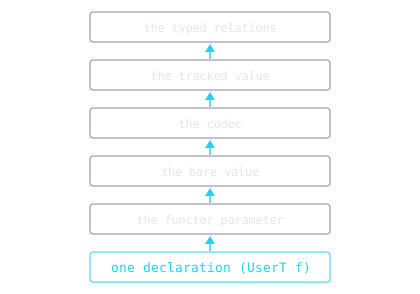
The earlier parts each settled one rung, and from a distance you can see they were never separate ideas. They are one declaration, read more and more sharply, until the types carry the bookkeeping the mutation can’t. Writing the working down before the code is what held the abstractions honest the whole way up. That a language which refuses to mutate forced the cleaner design, rather than forbidding the design at all, is the part worth keeping.